Legal AI built around the work.
Explore how Ardela helps litigation, private client, employment, property, and family teams capture speech, structure documents, and produce reviewable work.

Choose the practice.
Start from the job.
Each page focuses on the source material, recurring work, outputs, and professional controls that matter to that department, grounded in the way its legal work actually runs.
Litigation and dispute resolution
Capture hearings and conferences, organise document-heavy matters into cited chronologies, and move from source material to reviewable case work.
Litigation software for solicitors Explore Litigation and dispute resolutionPrivate client, wills and probate
Capture detailed instructions, structure estate papers, and prepare reviewable attendance notes and client documents with the human context intact.
Probate software for solicitors Explore Private client, wills and probateEmployment law
Record workplace meetings, structure tribunal material, and review employment contracts and settlement agreements with visible approval controls.
AI for employment lawyers Explore Employment law
Property and conveyancing
Extract title and lease information, record site visits, and turn document packs or dictation into reviewable property work.
AI conveyancing software Explore Property and conveyancingFamily law
Preserve sensitive instructions, prepare structured attendance notes, and keep court and correspondence drafts under fee-earner control.
AI for family lawyers Explore Family law One platform.
Practice-specific work.
The underlying controls stay consistent across the firm, while each department keeps the language, templates, and matter structure its work requires.
Capture the source before reconstructing it.
Use legal dictation, authorised meeting recording, or existing audio, then correct the transcript before generating work.
Structure documents and preserve every citation.
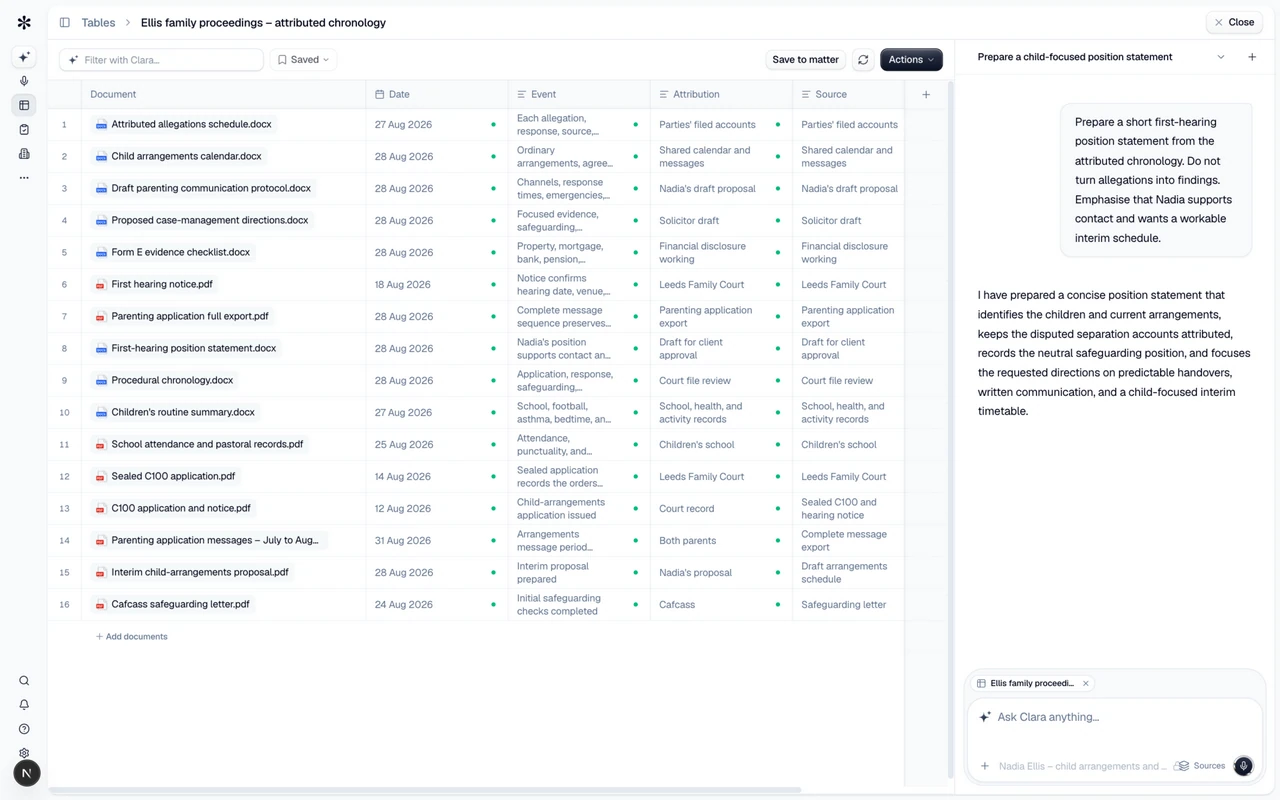
Tables extract the fields a team defines and keep answers connected to the source document.
Make AI changes visible and reversible.
Clara proposes rewrites and redlines for approval. Professional review controls what reaches the file or client.
Shared controls across
every department.
Inputs
Start from the material the team already has.
 Dictation and audio
  Authorised meetings
  Matter documents
  Firm templates
 Outputs and controls
Keep the work checkable before it goes anywhere.
 Cited answers
  Tracked proposals
  Human approval
  Workspace permissions
 Practice-area questions,
answered.
Which legal practice areas does Ardela support?
Ardela is built for England and Wales legal work across litigation, private client, employment, property, family, and other departments. The platform provides shared capabilities—dictation, transcription, drafting, review, matter knowledge, and approvals—while each team uses the templates, Tables, and workflows appropriate to its work.
Is Ardela practice management software?
Ardela includes clients, matters, tasks, deadlines, documents, time entries, permissions, and reporting. Its distinctive role is the work inside the matter: capturing speech, structuring source documents, drafting, and reviewing AI changes. Some firms may use it alongside an existing practice-management system.
Can each department use its own templates?
Plans with custom templates can use the firm’s document structure and letterhead for supported notes and documents. Template availability and rollout should be checked against the practice area, document type, and plan the firm is evaluating.
Does Ardela make legal decisions for the solicitor?
Ardela helps the team capture, organise, draft, and review. Generated work remains a draft, and an authorised fee-earner provides legal advice and decides what is accurate and appropriate to use.
Can we evaluate Ardela using our own workflow?
Yes. The most useful evaluation starts with a representative, appropriately protected example from the department: a recording, document pack, precedent, contract, or matter workflow. The team can then assess the output and controls against the way the firm actually works.


Bring a real workflow.
Test the complete path.
Evaluate a representative, appropriately protected example from the department, then have the supervising fee-earner test the source trail and resulting draft.