Workplace meeting records
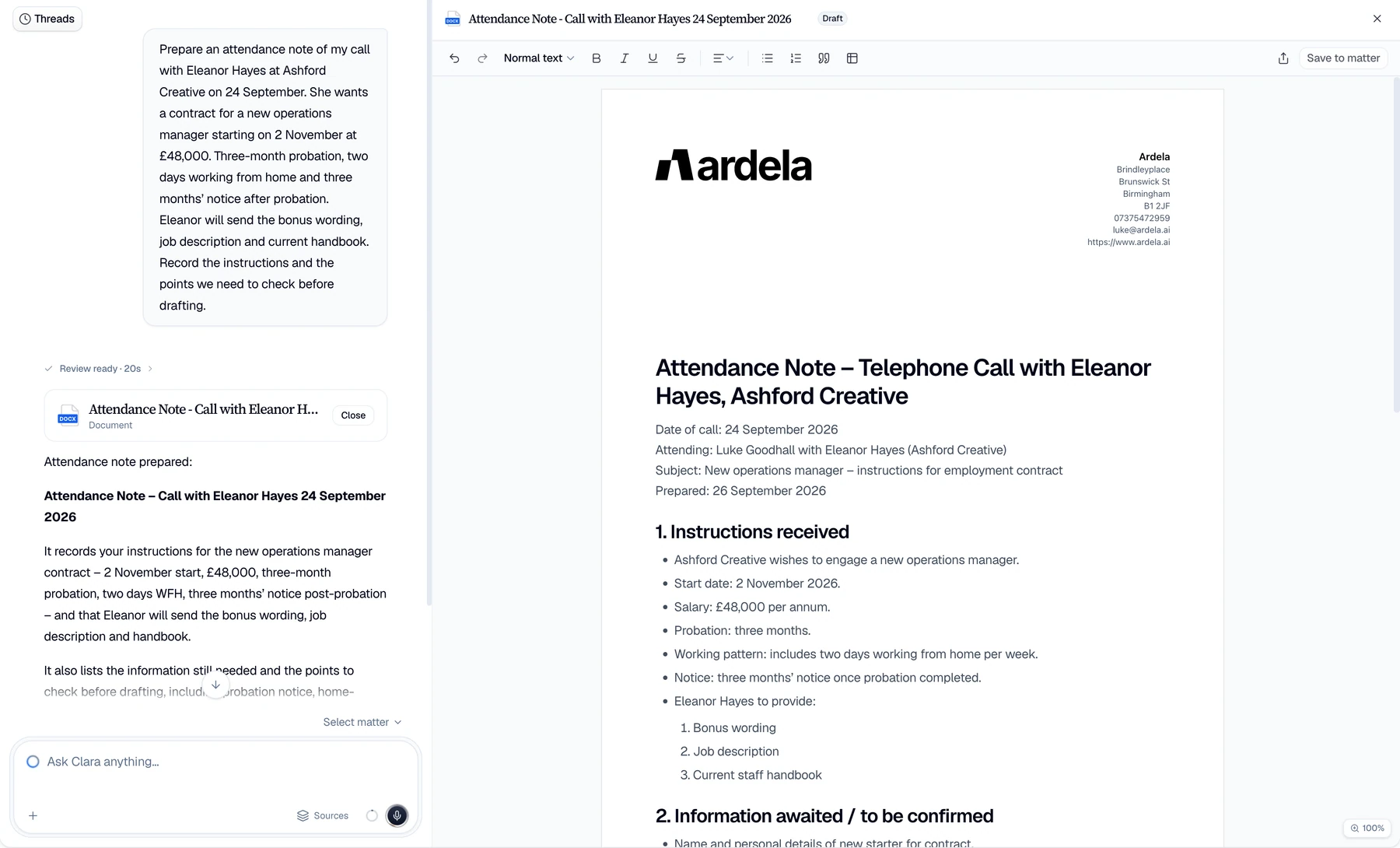
Prepare structured notes from authorised recordings or post-meeting dictation, retaining speaker attribution and the editable transcript.
Capture authorised workplace meetings, organise tribunal documents, and review contracts or settlement agreements for England and Wales matters with source-linked findings and approval-gated redlines.

Employment files grow through meetings, policies, correspondence, contracts, medical material, and settlement drafts. The team needs a reliable record before it can advise.
Meeting notes lose attribution and important wording.
Grievance, disciplinary, investigation, and settlement discussions become summaries that are difficult to check later.
Key terms are compared manually across documents.
Notice, pay, benefits, restrictions, claims, and proposed settlement terms are repeatedly copied into separate working notes.
Redlines lose their review position as versions multiply.
A quick rewrite can conceal why language changed, which side the review represents, and who approved the amendment.
Keep evidence, instructions, analysis, and proposed wording visible as the matter moves from investigation to advice or settlement.


Capture or dictate
Record a meeting only where authorised and appropriate, or dictate a note immediately afterwards. Edit the transcript before generating work.
Extract the terms
Use Tables to structure contracts, policies, correspondence, and settlement drafts into cited fields for comparison and review.
Review the wording
Run the document against the selected review position. Clara presents proposed changes as tracked, individually reviewable suggestions.
Ardela gives the team a checkable record and a controlled first draft, with employment-law judgment staying with the solicitor.
Prepare structured notes from authorised recordings or post-meeting dictation, retaining speaker attribution and the editable transcript.
Extract parties, dates, allegations, responses, documents, and key events into a cited working Table that the team can verify.
Review employment contracts and settlement agreements from an explicit employer or employee perspective, with proposed redlines held for approval.
Prepare grievance or disciplinary outcome letters and employment-tribunal witness-statement drafts from the checked record, ready for the solicitor’s legal assessment.
People and events
Preserve who said what and what happens next.
 Speaker-labelled meetings
  Fee-earner dictation
  Transcript correction
  Structured notes
 Terms and documents
Move from a file of versions to a review the team can control.
 Contract extraction
  Cited matter answers Word tracked changes
  Accept or reject each change
 Employment rights, status, privilege, admissibility, settlement validity, and tactical choices depend on law, facts, and instructions outside a software-generated summary.
Every review begins from a selected employer or employee position and keeps that objective visible throughout.
Findings are grounded in the uploaded document, and proposed Word changes can be accepted or rejected individually rather than overwriting the agreement.
The firm decides whether a workplace discussion should be recorded and obtains any required authority. Ardela also supports post-meeting dictation when recording is inappropriate.
Employment teams can use Ardela for authorised meeting transcription, post-meeting dictation, attendance notes, tribunal matter extraction, cited chronologies, contract analysis, settlement-agreement review, drafting, and matter search. Legal advice and the final work remain with the solicitor.
Yes. Ardela supports structured document review from an explicit employer or employee perspective. Findings are grounded in the document, and proposed redlines are produced as native Word tracked changes for individual acceptance or rejection.
Yes. A team can review a settlement agreement from the selected employer or employee perspective and inspect proposed changes. The employment solicitor assesses statutory validity and provides the advice required by law.
It can record and transcribe multi-speaker meetings where the firm has decided recording is lawful, appropriate, and authorised. Post-meeting dictation provides an alternative route to a structured note.
Ardela includes matter records, tasks, deadlines, documents, and time entries, but its strongest employment-law workflows are capture, structured document knowledge, drafting, and controlled review. A firm may use it alongside an existing practice-management system.
Clara presents rewrites and redlines as proposals. An authorised user decides whether to accept each change, and generated documents remain drafts for the supervising fee-earner to check before use.
Bring a representative employment contract, settlement agreement, or matter pack; every resulting note and redline remains a draft for the employment solicitor to approve.
Book a demo
Leave your details and we’ll arrange a short walkthrough for your firm.

