Hearing and conference notes
Turn a dictation or authorised recording into a structured note covering attendance, submissions, outcome, directions, deadlines, and next actions.
Capture what happened, structure what the documents say, and draft from the matter record. Ardela brings legal dictation, cited document review, and approval-gated AI into one litigation workspace.

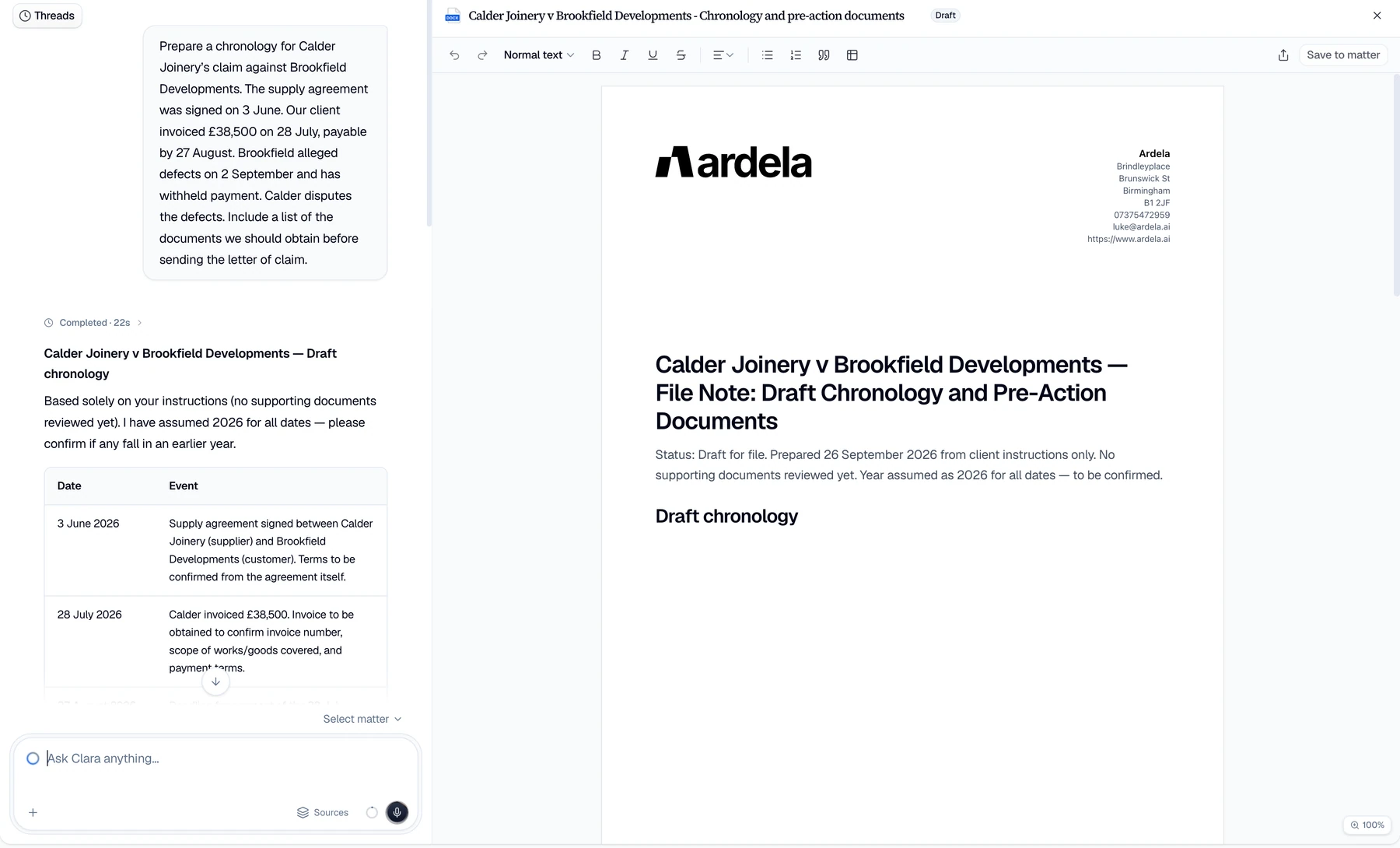
Litigation work is rarely short of information. The expensive gap is turning calls, hearings, statements, correspondence, and bundles into a record the team can actually use.
Important detail is trapped in audio and handwritten notes.
Fee-earners reconstruct hearings, conferences, and instructions before they can advise or draft.
Chronologies are rebuilt every time the document set changes.
Dates, parties, amounts, and events are copied into spreadsheets that leave the source trail behind.
Generic AI starts outside the matter and its controls.
Useful litigation work needs provenance, permissions, and a visible approval step alongside the draft.
Use the source that already exists—speech, documents, or both—then keep the supervising fee-earner in control of the output.


Capture the event
Dictate after a hearing, record an authorised conference, or upload existing audio. Correct names and figures in the transcript first.
Structure the papers
Add the relevant documents to a Table and extract the dates, actors, issues, and values the team needs, with citations to source.
Draft and approve
Generate the attendance note or working draft on the firm’s template. Clara proposes changes; an authorised person accepts them.
A litigation platform earns its place by removing reconstruction work while keeping legal judgment with the dispute team.
Turn a dictation or authorised recording into a structured note covering attendance, submissions, outcome, directions, deadlines, and next actions.
Extract dates and events across a document set into a working Table. Open the supporting source when a fact needs to be checked.
Bring the transcript and matter material together for first drafts, summaries, and client correspondence that remain subject to fee-earner review.
Prepare a witness-statement structure, letter before claim, response, or instructions to counsel from checked matter material for professional review and filing.
Capture
Create a dependable record while the detail is still fresh.
 Legal dictation
  Multi-speaker meetings
  Audio uploads
  Editable transcripts
 Structure and produce
Make the matter easier to scan, check, and progress.
 Cited extraction Tables
  Matter search
  PDF and DOCX drafts
  Approval-gated changes
 Ardela supports litigation preparation and matter work, while the solicitor owns prospects, advice, procedure, and every filing decision.
Tables keep extracted answers connected to their source documents so the team can verify the underlying passage instead of trusting an unsupported summary.
Roles, permission keys, and sharing grants limit who can see sensitive work. Database row-level security enforces the workspace boundary underneath.
Generated documents are drafts. Clara presents rewrites and redlines for approval; the supervising fee-earner remains responsible for the file.
Ardela is designed for the information-heavy work around a dispute: legal dictation, hearing and conference transcripts, attendance notes, document extraction, cited chronologies, matter search, drafting, and controlled document review. The solicitor remains responsible for strategy, advice, procedure, and filing.
Yes. A team can add relevant documents to a Table, define the dates and events it needs, and extract them with citations back to source. The result is a review aid, so the fee-earner should check material entries against the cited document.
Ardela includes clients, matters, tasks, deadlines, documents, and time entries. Its distinctive role is capture, drafting, review, and structured matter knowledge, whether used as a focused workspace or alongside an existing practice-management system.
Yes on plans that include custom templates. Drafts can use the firm’s document structure and letterhead, then export to PDF or DOCX. Template availability and rollout should be confirmed against the plan you are considering.
Ardela helps the legal team organise source material and produce reviewable drafts. A qualified solicitor provides legal advice and assesses the likely result of a dispute.
Recordings and documents are hosted in the UK by default, encrypted in transit and at rest, and protected by workspace permissions.
Use a representative bundle or recording to build a cited chronology or draft, then have the supervising fee-earner test every material proposition.
Book a demo
Leave your details and we’ll arrange a short walkthrough for your firm.

