Client attendance notes
Separate the client’s account, instructions, advice given, risks, decisions, and action points in a structured note that remains reviewable.
Capture sensitive client instructions, organise case documents, and prepare reviewable attendance notes, court notes, and correspondence under the legal team’s judgment.

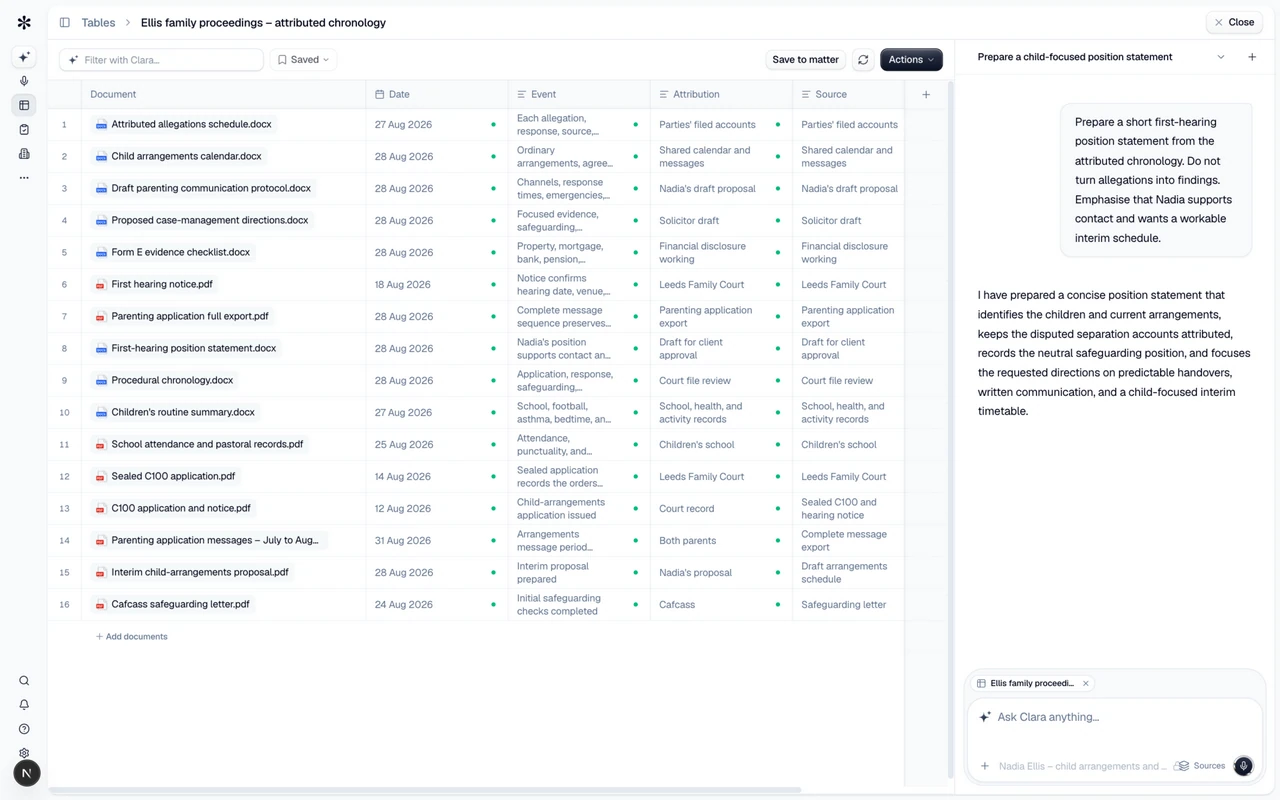
Family matters develop through long client conversations, changing instructions, correspondence, hearings, disclosure, and urgent next steps. A dependable file record matters.
The client meeting contains more detail than the note.
Relationships, concerns, allegations, advice, decisions, and actions are condensed after the event while the next task is already waiting.
Material facts sit across an expanding document set.
Orders, statements, schedules, correspondence, and financial records must be read together before the team can see the chronology.
Urgency makes generic automation more dangerous.
A family-law draft must preserve uncertainty, attribution, and professional judgment rather than turn disputed accounts into established fact.
Keep the client’s account distinct from advice, organise the source material, and make every AI change visible to the responsible fee-earner.


Capture appropriately
Record only where the firm has decided it is appropriate and authorised, or dictate a detailed note immediately after the attendance.
Correct and structure
Fix names, relationships, dates, and figures in the transcript, then organise relevant documents into a cited Table for the matter.
Generate and review
Create the supported attendance note or correspondence on the firm’s template. Review the draft and approve Clara’s changes before use.
The product should reduce retyping and reconstruction while keeping disputed facts, advice, and decisions in the hands of the legal team.
Separate the client’s account, instructions, advice given, risks, decisions, and action points in a structured note that remains reviewable.
Capture the hearing outcome, order, directions, deadlines, and follow-up work from a dictation or authorised recording while the detail is fresh.
Extract the dates, people, events, values, and issues the team needs into a cited Table connected to every source.
Prepare child-arrangements position statements, draft family orders, and letters of instruction to experts from checked matter material for solicitor review.
Capture and notes
Preserve context and attribution before drafting begins.
 Legal dictation
  Authorised meetings
  Editable transcripts
  Structured attendance notes
 Documents and drafting
Keep the source set connected to the work it produces.
 Case document uploads
  Cited extraction Tables
  Matter search
  Approval-gated edits
 Family law involves vulnerability, disputed accounts, safeguarding, procedural obligations, and professional decisions. Ardela keeps that context visible for the legal team.
Generated notes preserve who said what, keeping allegations and recollections clearly attributed for review.
Workspace roles, permissions, and sharing grants restrict access to sensitive recordings and documents. Database RLS enforces the tenant boundary underneath.
Notes and documents remain drafts for the supervising fee-earner to verify, apply legal judgment to, and approve for use.
Family teams can use Ardela for legal dictation, authorised meeting transcription, client attendance notes, court and conference notes, document extraction, cited matter Tables, drafting, and matter search. The solicitor remains responsible for advice, safeguarding decisions, procedure, and filing.
Yes. A fee-earner can generate a structured attendance note from an edited transcript using a supported template. The note can separate the client’s account, instructions, advice, risks, decisions, and actions, and must be reviewed before it is placed on the file.
Yes. Relevant documents can be added to a Table and extracted with citations back to source. Teams choose the fields they need and verify material dates, values, people, and events against the underlying documents.
Pro includes supported England and Wales form-fill workflows with field-level review. The team can confirm current family-form coverage and rollout status for the firm’s requirements.
Ardela includes clients, matters, tasks, deadlines, documents, and time entries, but its strongest family-law role is capture, notes, matter knowledge, drafting, and controlled AI changes. It can be evaluated alongside an existing practice-management system.
Clara presents each change for approval. The fee-earner reviews the draft and decides what is accurate, appropriate, and safe to place on the file or send onward.
Evaluate Ardela with a representative attendance or matter pack; every resulting note and draft remains under the supervising family solicitor’s control.
Book a demo
Leave your details and we’ll arrange a short walkthrough for your firm.

