Will and LPA instruction meetings
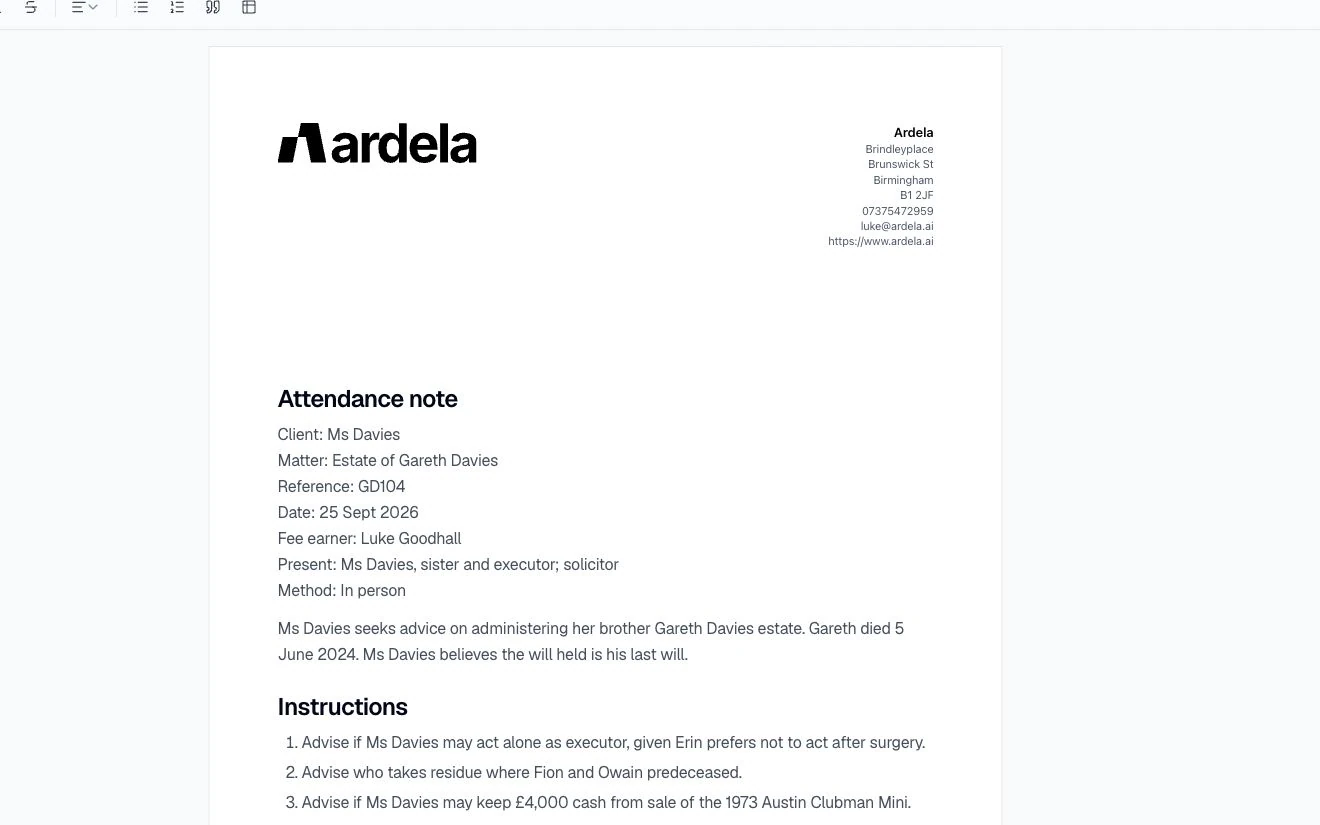
Preserve what the client said, the options explained, the decisions made, and the outstanding information in a structured attendance note.
Record sensitive instructions accurately, organise estate documents into cited Tables, and produce reviewable attendance notes and letters for wills, probate, and lasting-power-of-attorney work.

Private client matters turn on names, relationships, wishes, assets, capacity considerations, and careful explanation. Losing one fact creates more work and less confidence.
Long meetings become partial notes written from memory.
The solicitor must reconstruct instructions, warnings, decisions, and follow-up actions after an emotionally demanding conversation.
Estate information arrives across many documents.
Assets, liabilities, beneficiaries, and values are manually transferred into working schedules that leave the source trail behind.
Standard letters still need matter-specific care.
Templates help with structure, but the final document must reflect the actual instructions and remain under professional review.
Keep the spoken instructions, source papers, and resulting documents connected inside the same matter workspace.


Capture the instructions
Record an authorised meeting, dictate immediately afterwards, or upload audio. Correct identities, relationships, and figures in the transcript.
Structure the estate papers
Use Tables to extract the fields the team needs from wills, statements, valuations, and correspondence, with answers linked back to source.
Prepare the draft
Generate the attendance note or client document on the firm’s template, then review every material statement before export.
Give the solicitor a clearer record and a better starting draft while preserving the client relationship at the centre of the work.
Preserve what the client said, the options explained, the decisions made, and the outstanding information in a structured attendance note.
Collect assets, liabilities, people, dates, and values from the source set into a working Table, with citations for verification.
Draft from the transcript and matter context on firm letterhead, then use Clara’s approval cards to refine every visible change.
Prepare reviewable LPA advice, instructions records, and covering correspondence while leaving capacity, suitability, execution, and filing decisions with the solicitor.
Client work
Keep the human exchange available to the person preparing the file.
 Client meeting capture
  Post-meeting dictation
  Editable transcripts
  Attendance notes
 Estate work
Turn a document set into structured, checkable matter knowledge.
 Document uploads
  Estate extraction Tables
  Citations to source
  Approval-gated drafts
 Private client work involves capacity, vulnerability, family dynamics, tax, and execution questions that require the adviser’s full professional assessment.
The editable transcript remains available beside the generated work, helping the solicitor distinguish the client’s words from the draft produced from them.
Tables cite extracted answers to the supporting document. The team can inspect the passage before relying on an asset, value, date, or relationship.
The solicitor determines capacity, tax treatment, execution validity, and the legal effect of instructions. Every Ardela output remains a draft for that professional review.
Ardela can support the work around wills, probate, estate administration, and lasting powers of attorney: meeting capture, dictation, attendance notes, document extraction, cited Tables, drafting, matter search, and controlled document review. A solicitor still determines the advice and suitability of the final document.
Ardela is a probate productivity workspace for instructions, estate-document extraction, matter knowledge, and drafting. It works alongside specialist probate accounting, tax, court-submission, and estate-administration systems where the firm uses them.
Yes. Tables can extract selected fields from uploaded documents and cite each answer back to source. The team chooses the structure and should verify material values and classifications against the underlying document.
Plans with custom templates can generate supported notes and documents using the firm’s structure and letterhead. Because legal suitability and execution requirements depend on the matter, the supervising solicitor must review the resulting draft.
Pro includes supported England and Wales form-fill workflows with field-level review. Coverage depends on the form and rollout status, so firms should ask us to confirm the exact forms they need rather than assume complete catalogue coverage.
Recordings and documents are hosted in the UK by default, with encryption and workspace access controls.
See how Ardela captures instructions, structures estate papers, and prepares a draft for the supervising private-client solicitor to verify.
Book a demo
Leave your details and we’ll arrange a short walkthrough for your firm.

