Who it is for
Fee-earners and PAs who run client meetings, hearings follow-ups, or multi-party calls and then spend the next hour reconstructing who said what.
Capture a multi-speaker client meeting with speaker labels, edit the transcript, then generate the attendance note instead of starting from a blank page.

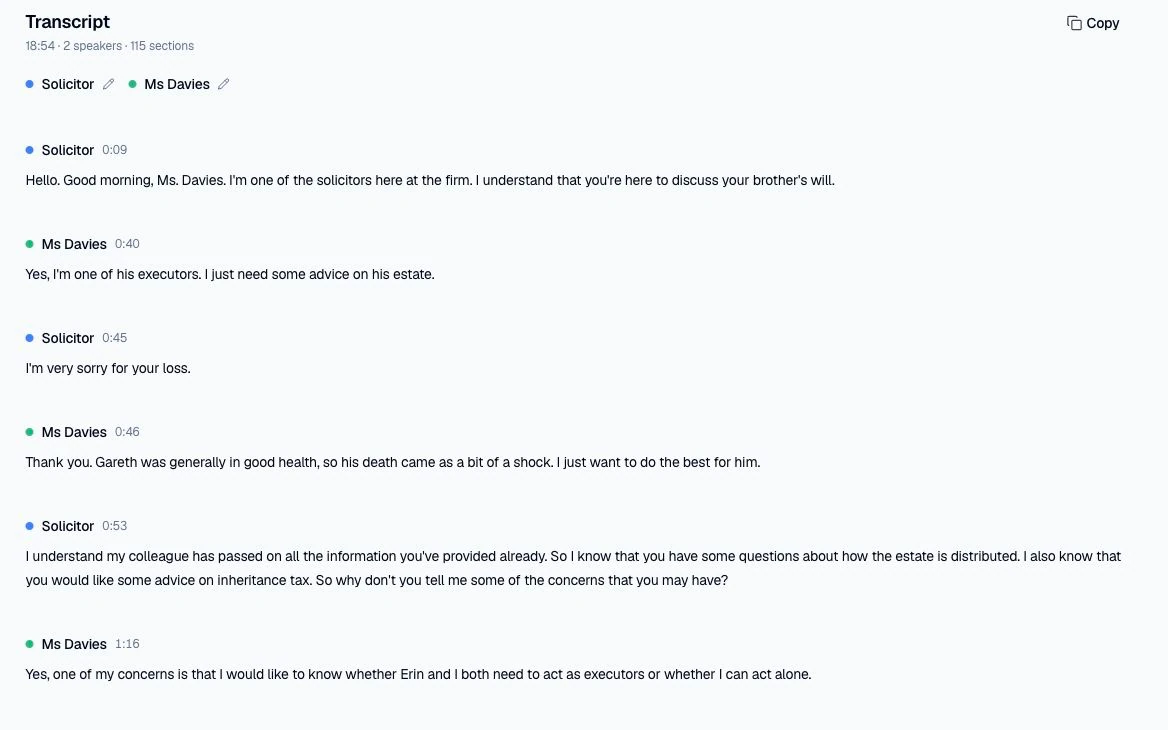
Generic meeting bots dump text. Legal teams need speaker labels, a chance to correct the record, and a path onto the firm’s attendance-note template.
The hour after the call is spent reconstructing the room.
Speaker identity is guessed later, badly.
The note reaches the firm template only after another retype.
Start meeting mode, correct speakers while it is fresh, then generate the attendance note.


Capture the meeting
Multi-speaker recording with diarisation, microphone, and optional screen capture.
Label the voices
Review speaker labels and correct names while the conversation is still in mind.
Generate the note
Apply the attendance-note template. Approve or reject any Clara rewrite before it is filed.
Audience
Fee-earners and PAs who run client meetings and calls.
 Client meetings
  Multi-party calls
  Hearing follow-ups
 Inputs
Spoken work, with more than one voice in the room.
Speaker diarisation Microphone capture  Screen capture
 Outputs & controls
A labelled transcript, then a draft the supervisor will own.
 Editable transcript
  Attendance note
  Approval cards
  Workspace access
 Diarisation separates voices, and the team confirms identity and corrects the transcript. Audio quality, accents, and overlapping speech shape the result, so human verification remains part of the workflow.
Fee-earners and PAs who run client meetings, hearings follow-ups, or multi-party calls and then spend the next hour reconstructing who said what.
The recording is workspace-scoped. Granular permissions limit who can play it back. Recordings are hosted in the UK by default. SAML SSO is Enterprise-only.
See attendance notes for the document this workflow produces, or Voice for capture across dictation and meetings together.
Learn more
Yes. Meeting mode can separate voices into speaker labels. A person should confirm the names and correct the transcript while the conversation is still fresh.
Diarisation separates voices into speaker labels. The legal team confirms each identity and checks the transcript against the recording.
Yes. After the transcript and speaker labels are corrected, Ardela can create a draft attendance note on an available firm template for human review.
The firm does. It should decide whether recording is appropriate, explain the purpose, and obtain any authority required by its professional, contractual, and data-protection obligations.
With the required authority, try Voice on an appropriately protected client call, correct the speakers, and have the supervising fee-earner review the note.
Book a demo
Leave your details and we’ll arrange a short walkthrough for your firm.

